

«Today your memories are worth gold»
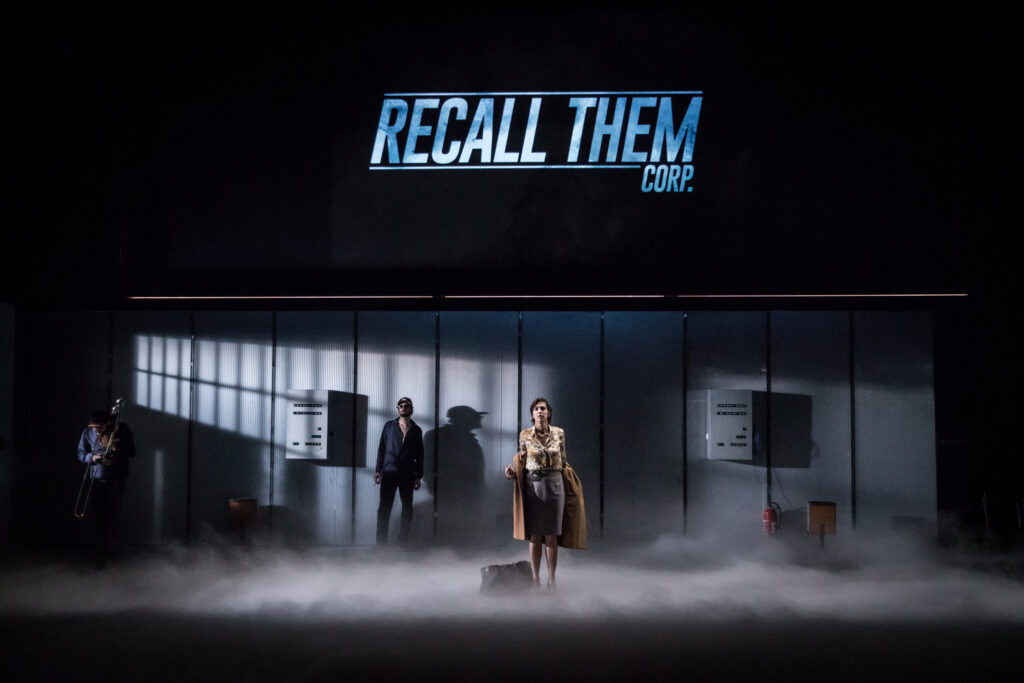
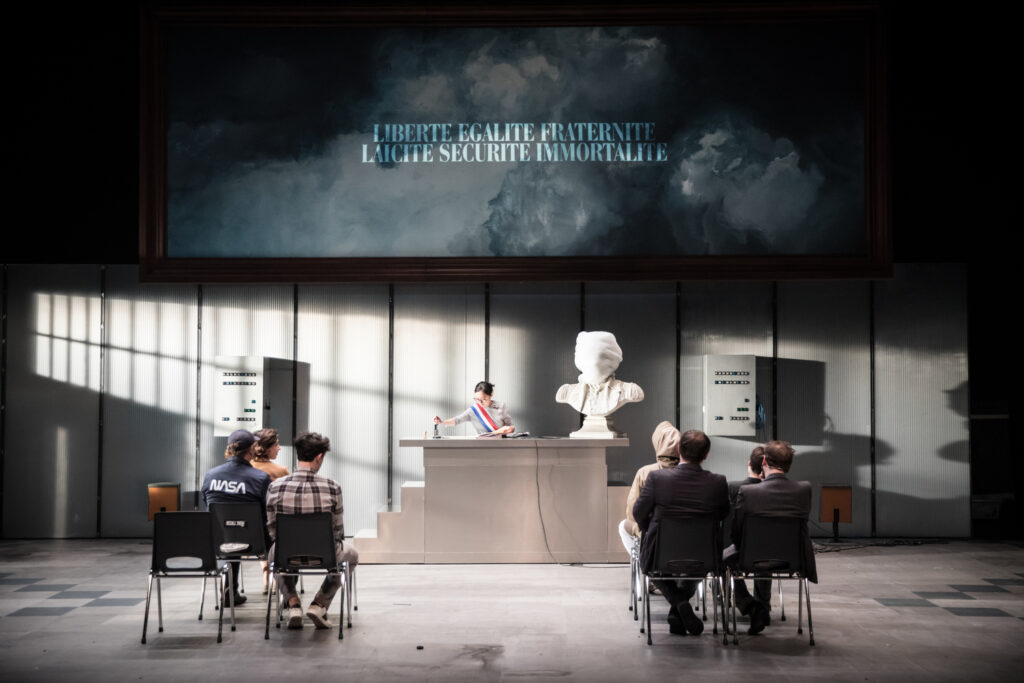
This world’s cornerstone is the invention of the Dismemoriser, a groundbreaking technology that can receive and store a person’s memories. Using it everyday is a prerequisite to insure a successful return to the living. Made in France, the Dismemoriser is a capitalistic tool that provides payment for each memory deposited. In order to insure national stability, any representation of human faces is forbidden. For obvious attachment reasons (for instance the memory of a loved one), filming, taking pictures or painting faces is no longer in allowed. France-fantôme’s universe created a new cultural era, a futuristic iconoclasm: the Ninth Scopic Revolution.
I wish to talk about discourses. About the way each of our society’s institutions — State, market, intellectual community, religious institutions — manages to take hold of a world’s rules in order to establish their power. How does the charm of these discourses operate? In such dystopia, what spaces could be used for an uprising?
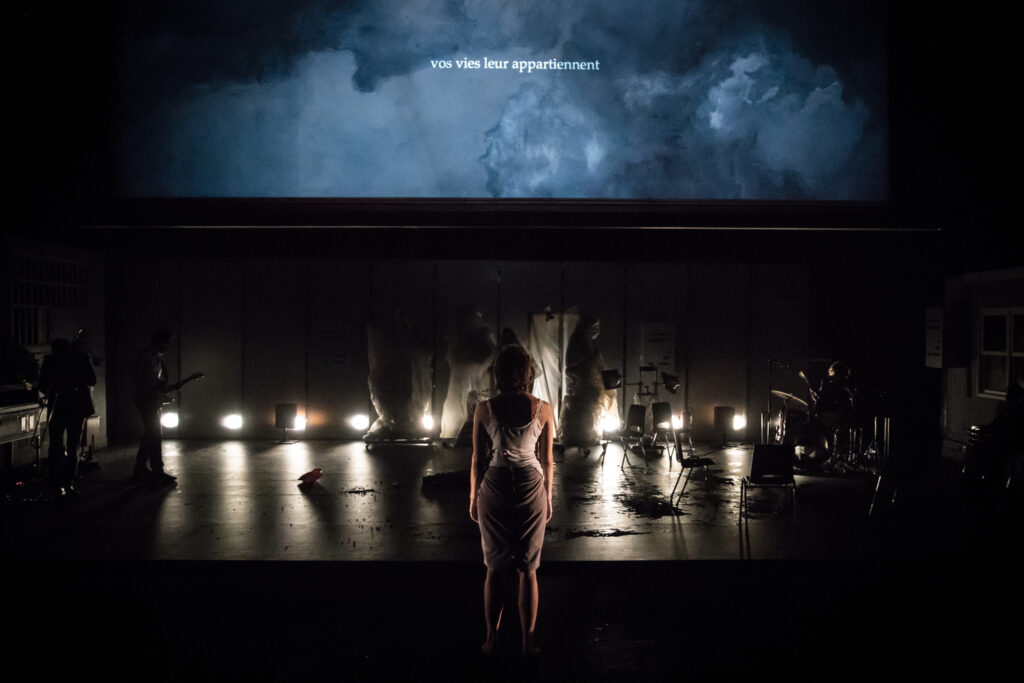
I would also like to talk about bodies. What is the mystery of embodiment? What is it like, to live in a body one has not chosen? France-Phantome can also be read as an allegory for our world’s digital mutation. A lightning, attractive, but also obscure, allegory. I wanted to deal with algorithms and data in the manner of gothic poets, the first science-fiction writers: they I used the sublime to talk about the invention of electricity, of storms and natural disasters. The sublime encompasses both the horror and the fascination one feels when faced with an uncontrollable, overwhelming power
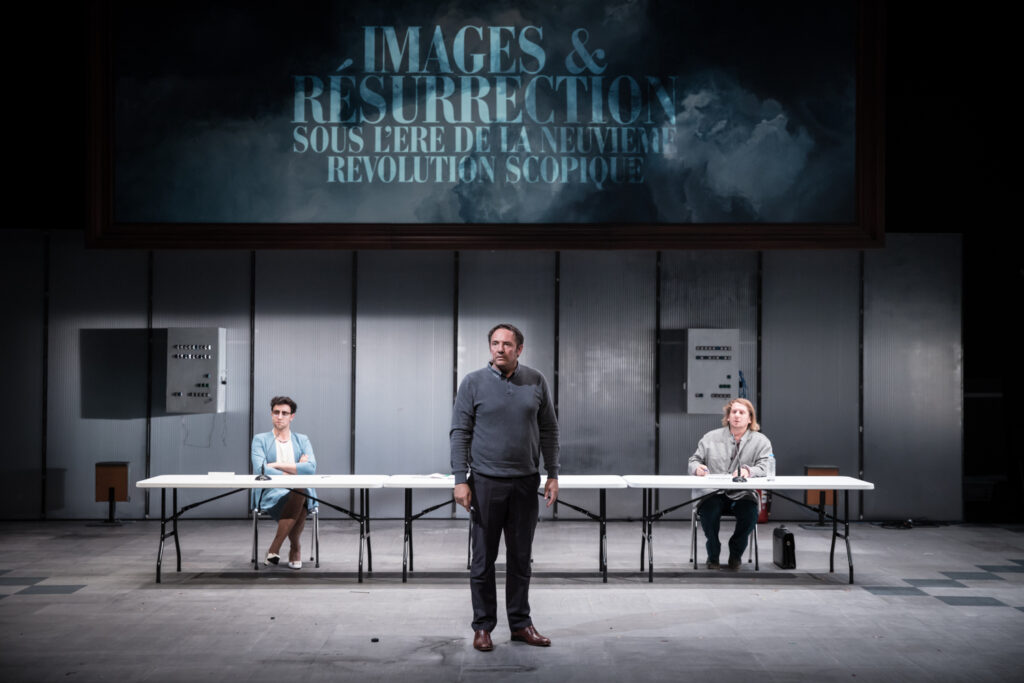
France-Phantome is a story of love and propaganda. It is also a woman’s impossible quest. Véronique is looking for her life’s missing picture the way some would search for the face of God. This show is my naive and sensitive attempt at finding singularity, humility, universality and sacredness in every single human face. A “mastery of faces”, to paraphrase Lévinas. The religion of our time may be love, but nostalgia will be the religion of the future. I wrote France-Phantome as a distorting mirror for my life and as the worlds’ negative film. A negative is a photograph’s embryo, its upside down; even if the colours are inaccurate, each shape is perfectly recognisable.
Tiphaine Raffier – 2017
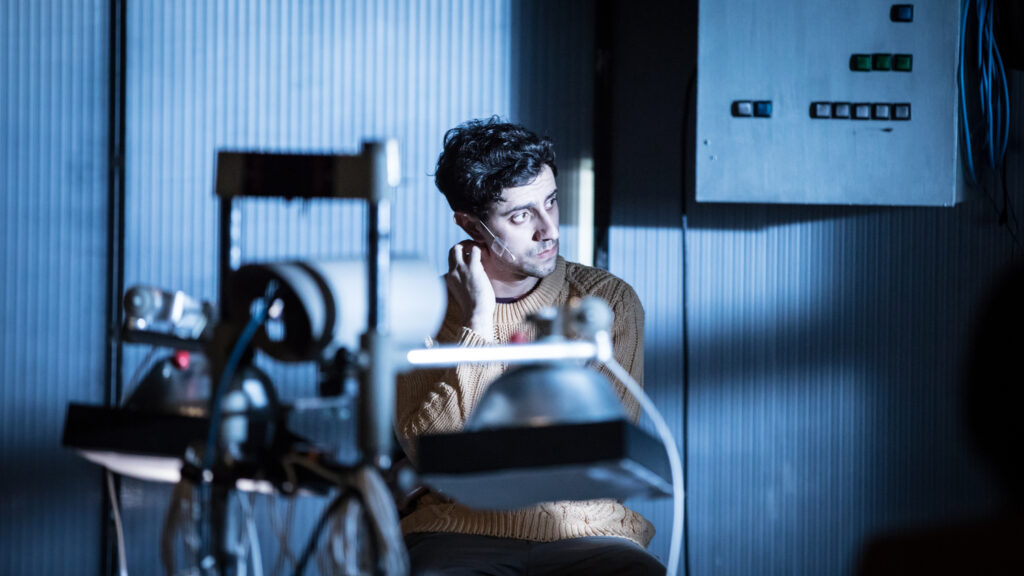
© photo : Simon Gosselin
Work on the script began during the AFDAS workshop “Créer en collectif” (Creating as a Collective), which took place at La Comédie de Béthune in June 2015, with the SVPLMC Collective.
A first draft was presented as a staged reading as part of the Jamais lu festival at Théâtre Ouvert in Paris in October 2015 and at Théâtre Aux Ecuries in Montreal in May 2016, with support from the CNT and the CALQ.
This production premiered in 2017 at the Théâtre du Nord in Lille.
Written and directed by Tiphaine Raffier
With Guillaume Bachelé, François Godart ou Sharif Andoura, Mexianu Medenou ou Teddy Chawa, Edith Mérieau
Rodolphe Poulain, Haïni Wang, Johann Weber
And the musicians Marie Eberle, Pierre Marescaux
Assistants Lyly Chartiez-Mignauw et Lucas
Samain
Scenography Hélène Jourdan
Costumes Caroline Tavernier
Lighting Mathilde Chamoux
Lighting Director Benjamin Trottier
Music Guillaume Bachelé
Sound Frédéric Peugeot
Sound Mixer Hugo Hamman et Martin Hennart
Video Pierre Martin Oriol
Video Director Pierre Hubert
General Manager Olivier Floury
Stage Manager Laura Millard
Administration and production Véronique
Atlan Fabre, Juliette Chambaud, Charlotte
Pesle Beal
Production La femme coupée en deux /
Théâtre du Nord, CDN Lille – Tourcoing –
Hauts-de-France
Coproduction Scène nationale 61, Alençon
/ Le Phénix, scène nationale de
Valenciennes / La Criée, Théâtre National
de Marseille / La rose des vents, Scène
nationale Lille Métropole, Villeneuve d’Ascq
/ Le Théâtre de Lorient – Centre
Dramatique National.
With the support of the ministère de la
Culture et de la Communication – DRAC
Hauts-de-France, DICREAM, Dispositif
d’insertion de l’École du Nord and of l’Onde
– Vélizy-Villacoublay.
Durée 2h30
